— work/enterprise telecom
ux audit + ia · 2022

Auditing the Add-A-Line flow at T-Mobile for Business — finding the friction points in a Fortune-100 SMB checkout.

Senior UX & Process Analyst on T-Mobile for Business — the Un-carrier's SMB shop. Audited the Add-A-Line product detail page and the SIM-activation flow used by small and mid-size businesses to provision new lines on Business Unlimited plans. Documented compliance and usability gaps across the digital business process and presented findings to internal leadership to influence roadmap prioritisation.

— who

T-Mobile for Business — the Un-carrier's SMB shop and self-service activation flow

— what

Process audit · UX audit · digital-business-process compliance · roadmap input

— result

Audit of the Add-A-Line / SIM-activation flow · findings presented to internal leadership · recommendations folded into roadmap prioritisation

— scope

Senior UX & Process Analyst · process audits · UX audits · stakeholder presentation

T-Mobile for Business — Activate a SIM Card page. Sidebar navigation on the left, SIM activation form in the center with device-type selector, plan picker showing Business Unlimited Advanced at $75/mo, Business Unlimited Ultimate at $90/mo, and Business Unlimited Select at $65/mo, additional services tabs for Data / International / Other, and a sticky summary card on the right showing $0 due now and $75/mo recurring.

— outcomes

Fortune 100

enterprise scale of the engagement

3

business-unlimited plan tiers reviewed in the audit (Advanced, Ultimate, Select)

1

Add-A-Line PDP audited end-to-end against process and UX heuristics

outcome

Audit findings that fed the SMB roadmap.

The engagement was not a redesign — it was a structured audit of an existing high-volume flow on a Fortune-100 carrier's shop. The Un-carrier's SMB segment was rapidly expanding and the Add-A-Line PDP was the load-bearing surface for that growth: every new business line a customer provisioned passed through this page, the plan picker, and the SIM-activation form.

Findings were documented against process-compliance and UX heuristics, then presented to internal leadership. The deliverable was not a Figma file — it was a defensible written record that the platform team and the SMB business owners could prioritise against. For a Fortune-100 carrier, that defensibility is the point.
users + needs

Designing for SMB IT buyers — not consumer phone shoppers.

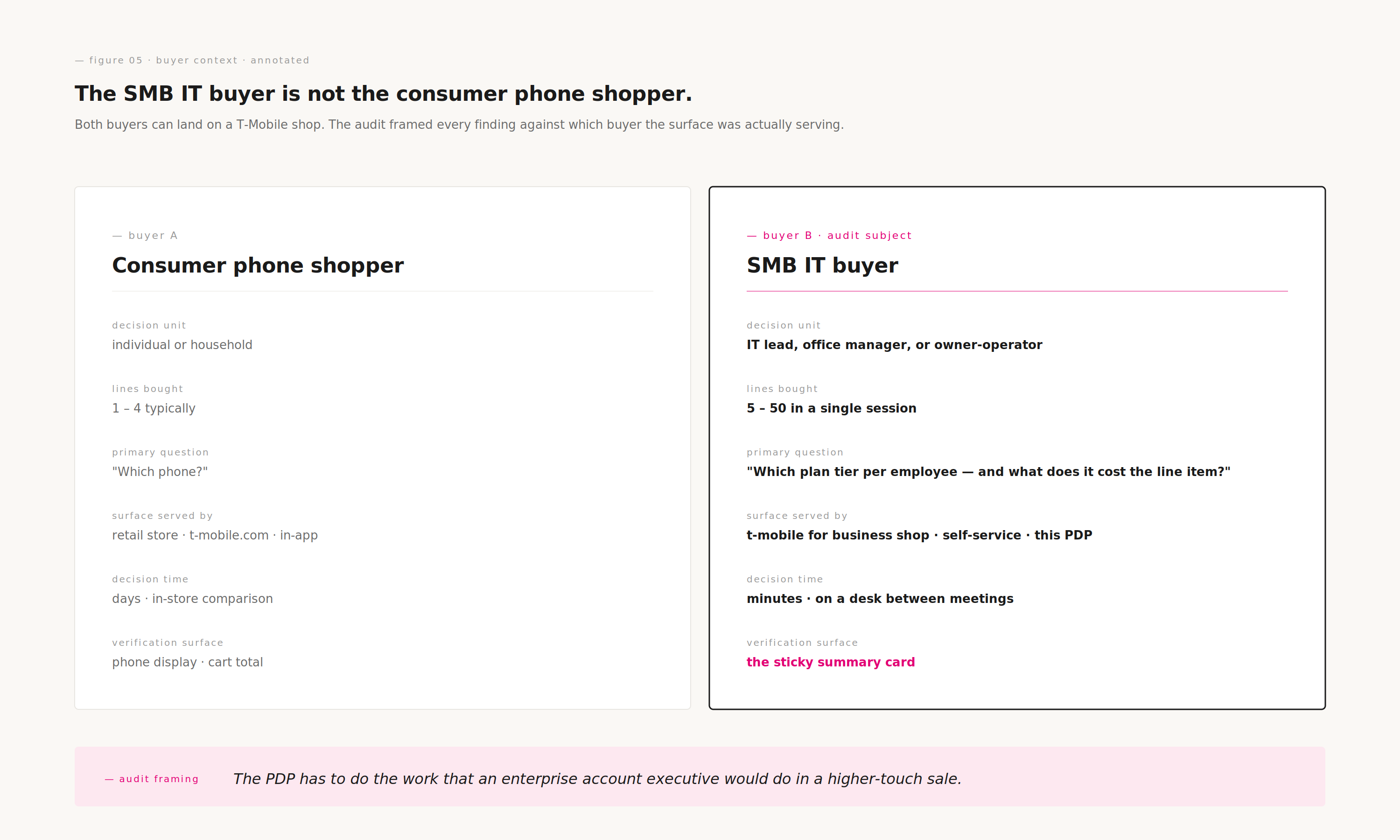
The buyer here is not the consumer customer who walks into a T-Mobile retail store. The buyer is an SMB IT lead, an office manager, or an owner-operator provisioning lines for employees — someone making a multi-line commercial decision under time pressure, often on a desk without a dedicated procurement workflow.

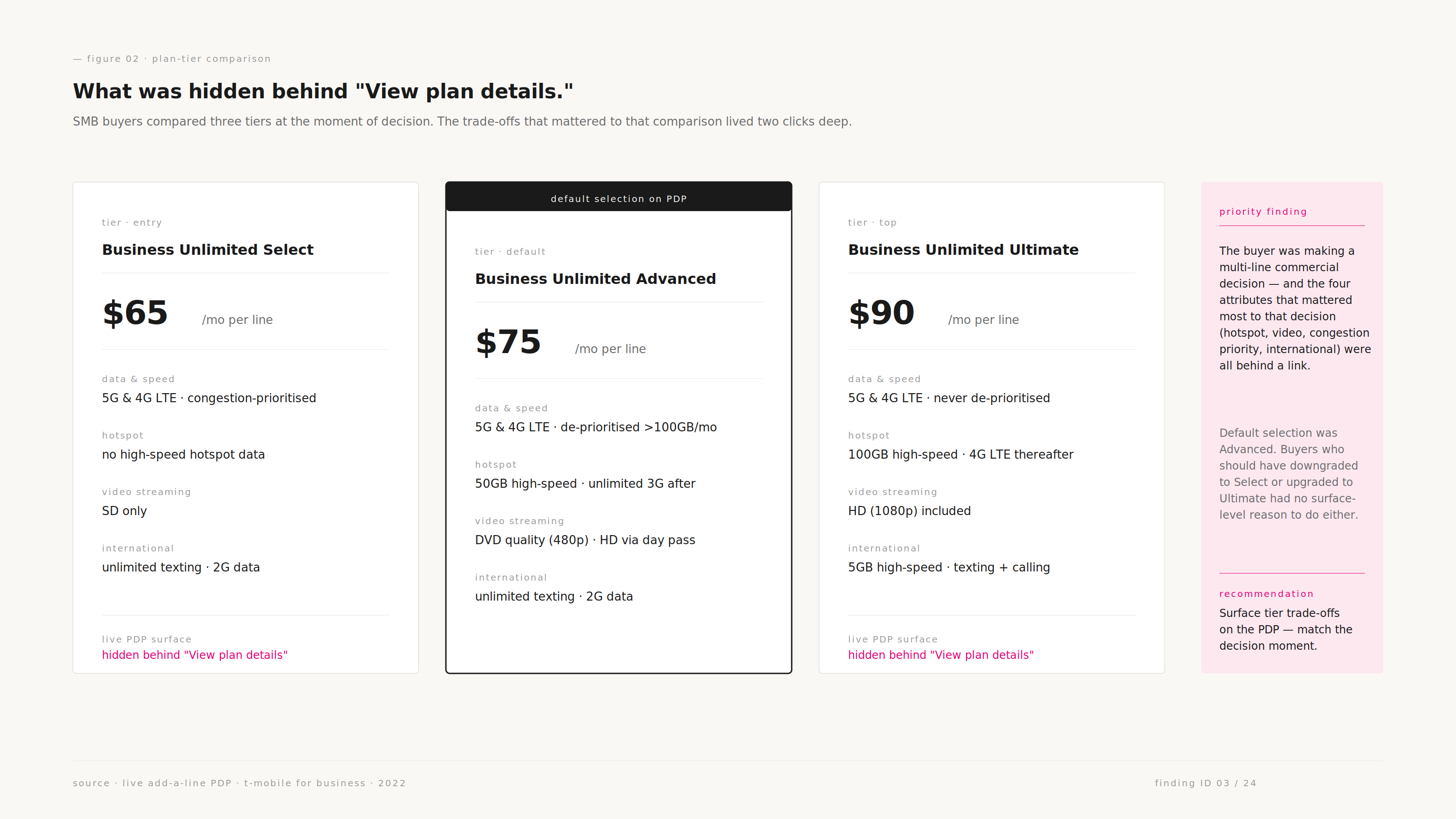
These buyers compare three Business Unlimited tiers — Advanced, Ultimate, and Select — at price points from $65/mo to $90/mo per line. They are also adding services (data add-ons, international features, other extensions) and reading the fine print: hotspot allowances, video-streaming quality, congestion-prioritisation language, 5G coverage notes. The PDP has to do the work that an enterprise account executive would do in a higher-touch sale.

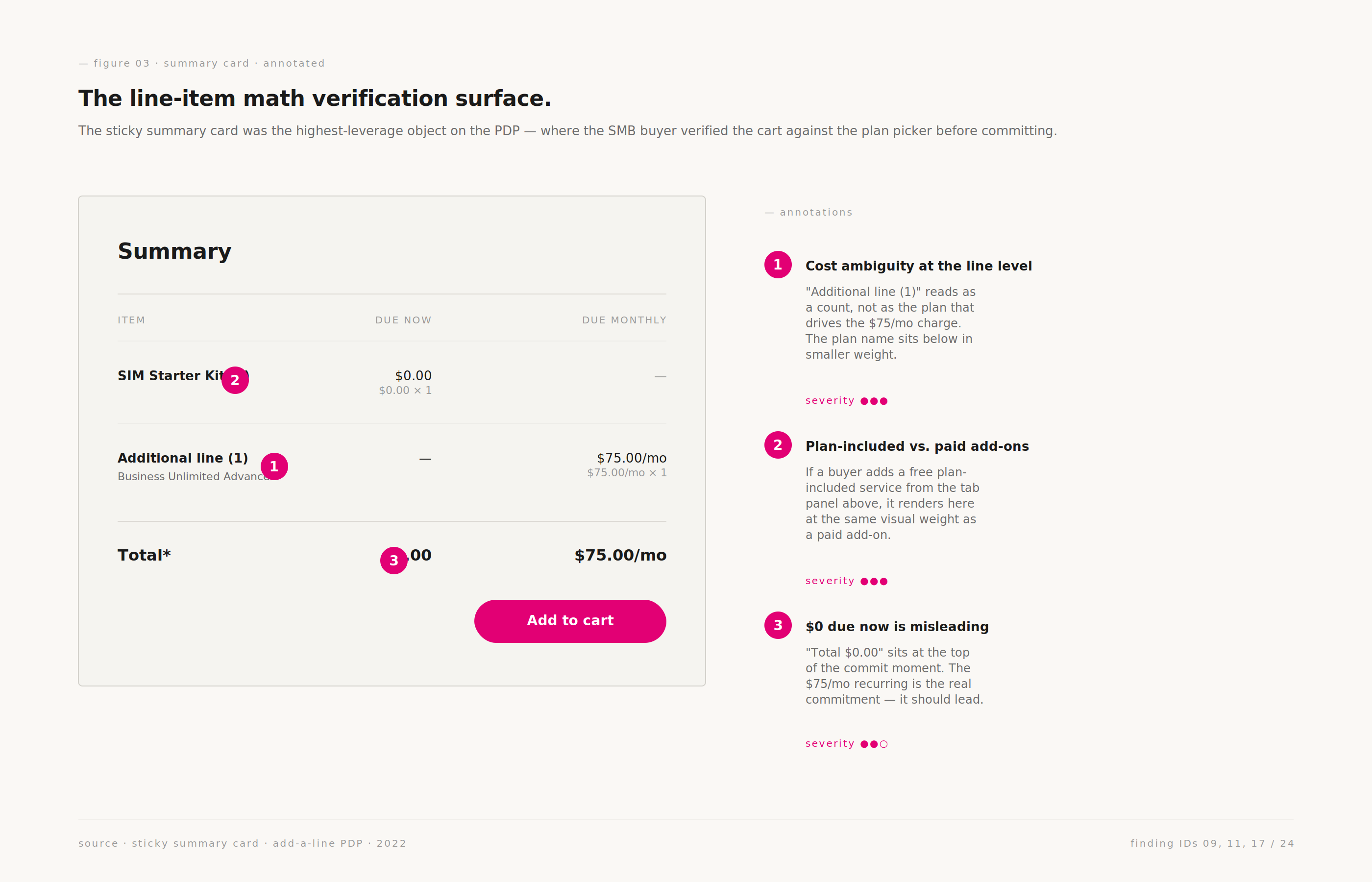
Two friction patterns kept surfacing during the audit: the plan-comparison surface buried the differences between tiers behind "View plan details" links rather than showing the trade-offs at the moment of decision, and the additional-services panel mixed plan-included features with paid add-ons in a way that made the line-item math hard to verify against the summary card on the right.

my role

Senior UX & Process Analyst inside the SMB platform team.

I sat between the platform's product owners, the design organisation, and the operations group that owned the post-purchase activation pipeline. Each of them had a stake in the same surface: product owned the conversion narrative, design owned the brand expression and the Un-carrier voice, operations owned what happened after the order hit "Add to cart."

My specific responsibilities were the end-to-end process audit of the Add-A-Line flow, the UX audit of the PDP and the SIM-activation form, the compliance review against internal digital-business-process standards, and the leadership presentation that translated findings into roadmap-prioritisable items.

the mandate

Audit a high-volume SMB flow on a fixed platform — and tell us what to fix first.

The brief was specific: audit, do not redesign. The platform was live, the SMB business unit was scaling, and the question on the table was prioritisation — what should the next quarter of platform investment buy. Anything that required a multi-quarter rebuild of the underlying shop was out of scope for the audit phase. The success bar was a written audit that internal leadership could defend in a roadmap conversation.

phase 01 · process audit

Process audit — mapping the digital business process end-to-end.

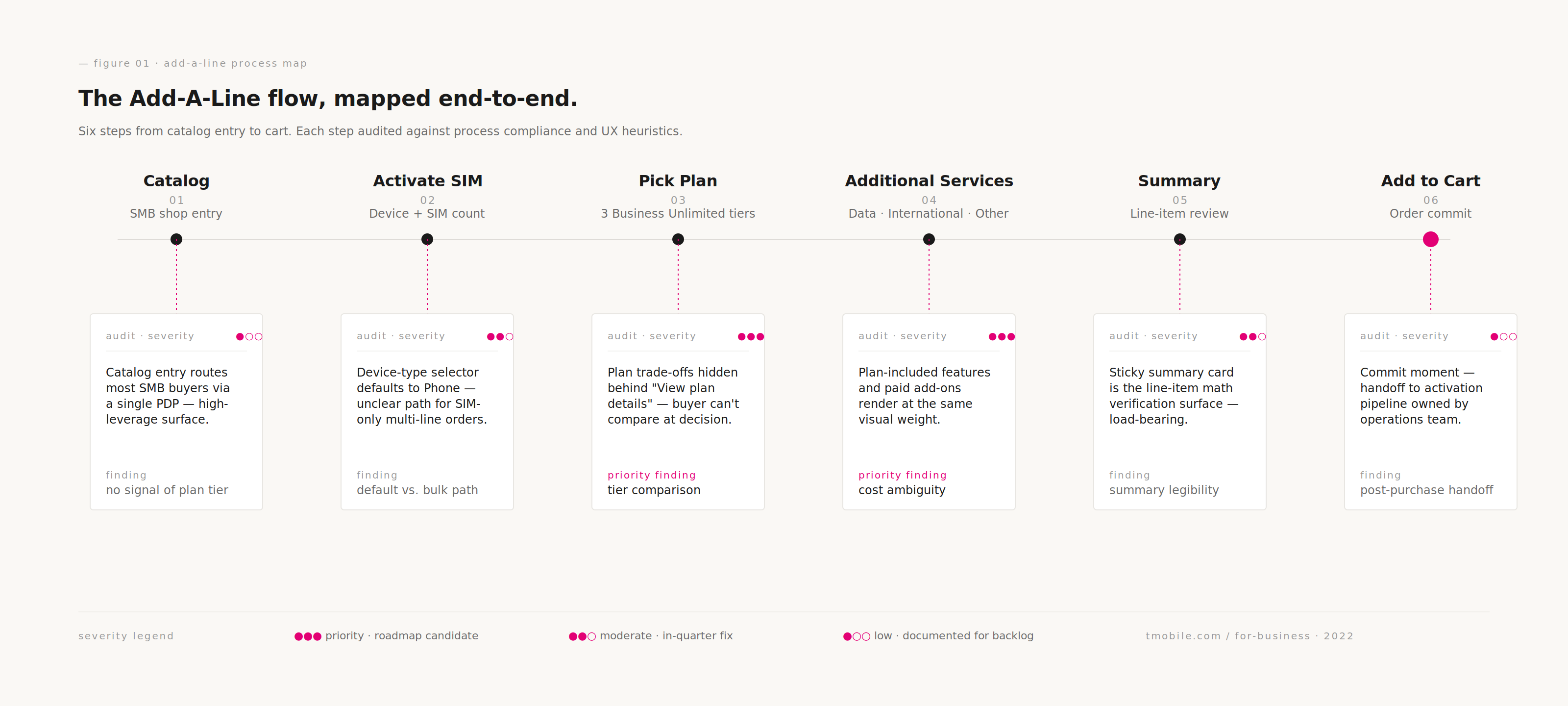
I mapped the Add-A-Line flow as a digital business process — every step from catalog entry through SIM activation, plan selection, additional-services configuration, summary review, and add-to-cart. Each step was annotated against process-compliance criteria: input validation, error recovery, state preservation across navigation, and the post-purchase handoff to the activation pipeline.

The output was a process map with two annotation layers: one for compliance gaps (places where the flow violated internal digital-business-process standards) and one for UX-heuristic violations (places where the surface itself created friction independent of the underlying process).

phase 02 · ux audit

UX audit — heuristic review of the Add-A-Line PDP.

The PDP itself went through a heuristic review against Nielsen's usability heuristics, with extra weight on three categories the SMB buyer relied on: visibility of system status (the sticky summary card), match between system and the real world (plan-comparison language and Business Unlimited trade-off framing), and consistency and standards (alignment between the shop, the activation form, and the brand surface treatment per the T-Mobile brand guidelines — TeleNeo, Magenta hero, Un-carrier voice).

The plan picker, the additional-services tabbed panel, and the sticky summary card were each documented as separate audit objects with their own findings and recommendations. The summary card was the highest-leverage object: it was the surface where the SMB buyer verified the line-item math before committing.

phase 03 · presentation

Findings presentation to internal leadership.

I presented the audit to internal platform and SMB-business leadership. The presentation was structured to be roadmap-actionable — every finding was tagged with severity, scope of fix, and which team owned the remediation. The format was deliberately not a slide deck of screenshots; it was a written audit document with a slide presentation overlay, designed to leave behind a defensible artifact after the room emptied.

Recommendations fed roadmap prioritisation for the following quarters. The audit was the input; the platform team owned the output.

visual evidence

What was audited: the Add-A-Line PDP.

Visual evidence shown above and below: the live Add-A-Line / Activate a SIM Card page on T-Mobile for Business, captured during the engagement window. Sidebar IA on the left (Dashboard, Manage Accounts, Manage Users, Shop, Billing). Activation form in the center with device-type selector, SIM-card count, and scan-or-enter input. Plan picker showing the three Business Unlimited tiers — Advanced ($75/mo), Ultimate ($90/mo), Select ($65/mo). Additional-services tabbed panel with Data, International, and Other. Sticky summary card on the right with the line-item breakdown and the Add-to-cart action. Additional artifacts (process map, audit document, leadership presentation) are not published — they remain confidential to T-Mobile for Business.

Process map of the Add-A-Line flow with six steps and audit-severity annotations
Process map — six steps from catalog entry to add-to-cart, each annotated with audit-severity and finding type.
Plan-tier comparison of Business Unlimited Select, Advanced, and Ultimate against the live PDP surface
Plan-tier comparison — Select $65/mo, Advanced $75/mo, Ultimate $90/mo. The trade-offs that mattered to the SMB buyer were two clicks deep on the live PDP.
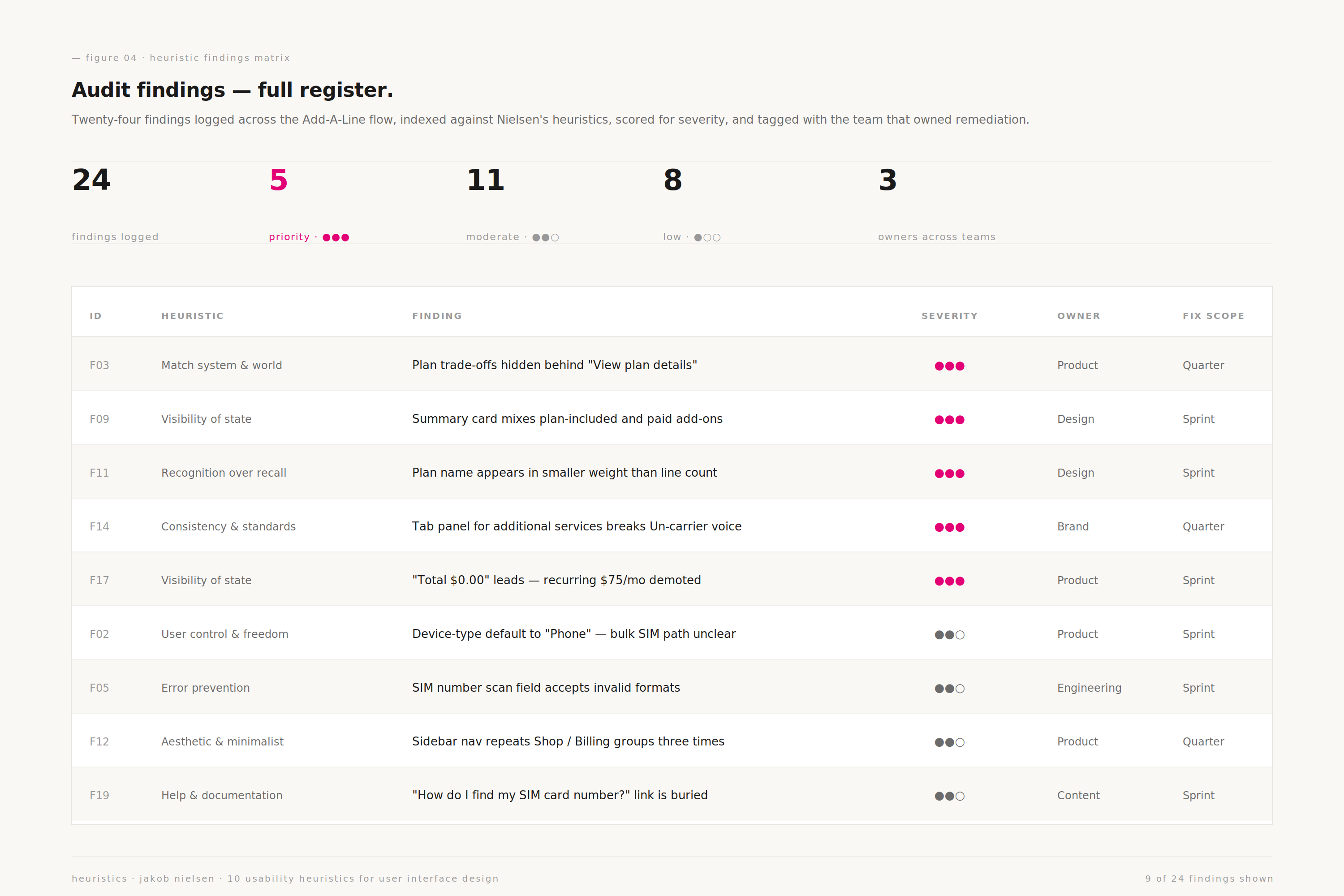
Heuristic findings matrix — 24 findings logged across the Add-A-Line flow with severity and owner tags
Heuristic findings matrix — 24 findings against Nielsen's heuristics, each tagged with severity, owning team, and fix scope.
Buyer context comparison — consumer phone shopper versus SMB IT buyer
Buyer context — the audit framed every finding against the SMB IT buyer the surface was actually serving, not the consumer phone shopper.
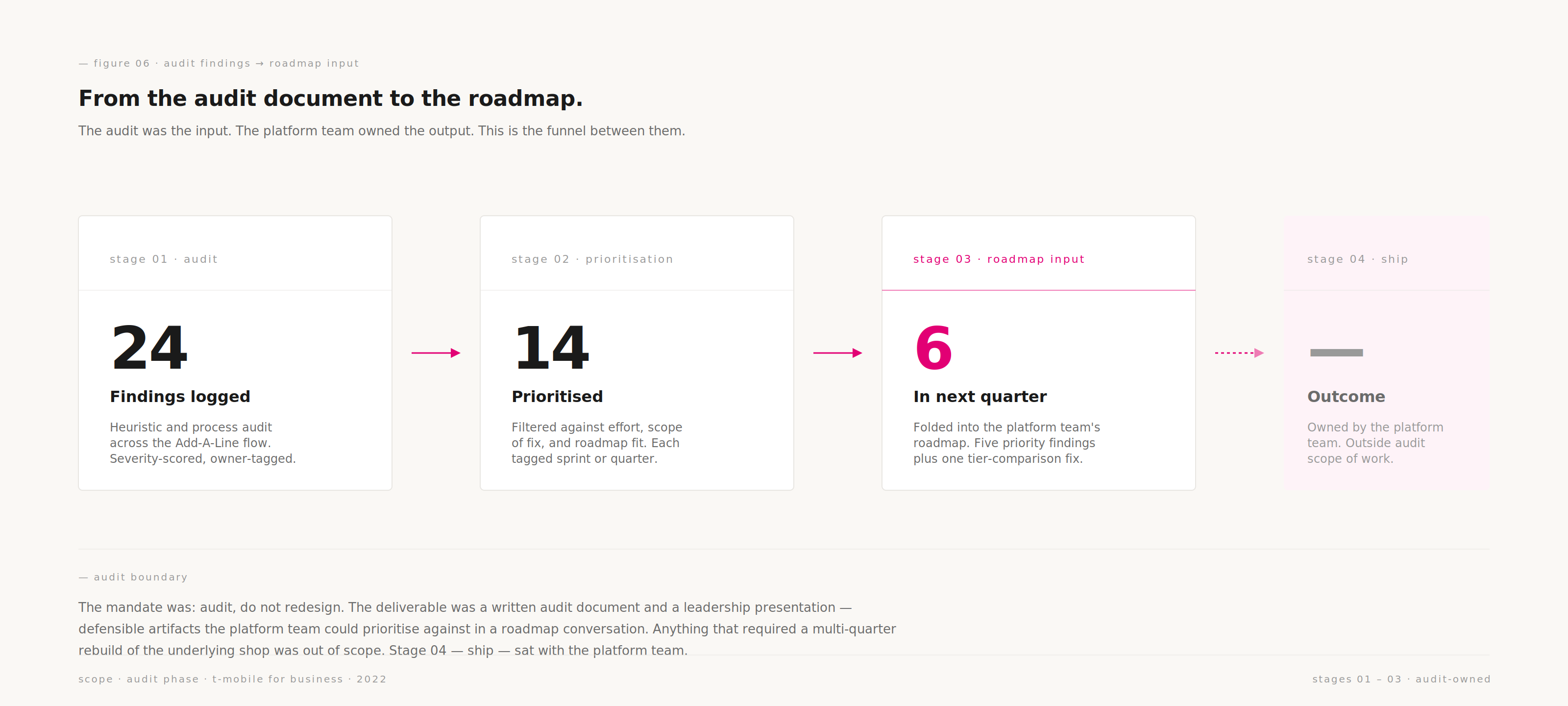
Funnel from 24 audit findings to 14 prioritised items to 6 roadmap-input items for the next quarter
Audit-to-roadmap funnel — 24 findings logged · 14 prioritised against effort and scope · 6 folded into the next quarter's platform roadmap.

— bottom line

Audit of the Add-A-Line PDP and SIM-activation flow on T-Mobile for Business · 3 Business Unlimited plan tiers reviewed (Advanced $75/mo, Ultimate $90/mo, Select $65/mo) · findings presented to internal leadership and folded into roadmap prioritisation.